
Roll 8d8 — D8 Dice Roller
Roll eight eight-sided dice below, or choose another whole number from 1 to 100. See each die, the total and its probability. Modifiers are whole numbers; damage cannot fall below zero. Resistance halves the result and rounds down.
- Free to use
- No sign-up
- Runs in your browser

Quick answer
Roll 8d8 means roll eight eight-sided dice and add the faces. With no modifier, critical doubling or Resistance, the total ranges from 8 to 64 and averages 36. Change the base dice count from 1 to 100 below; the roller and probability chart use the same damage adjustments.
D8 roller
Average damage per attack
Roll history
Tabletop Dice and Damage Pack
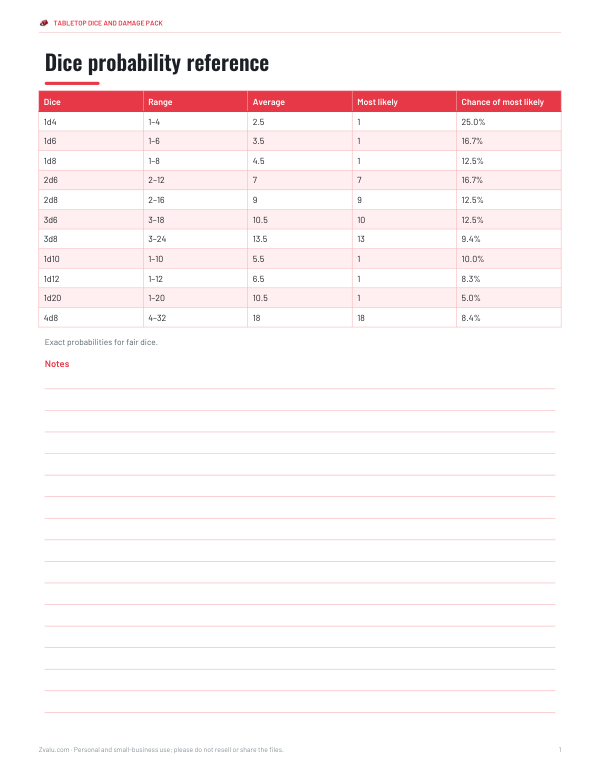
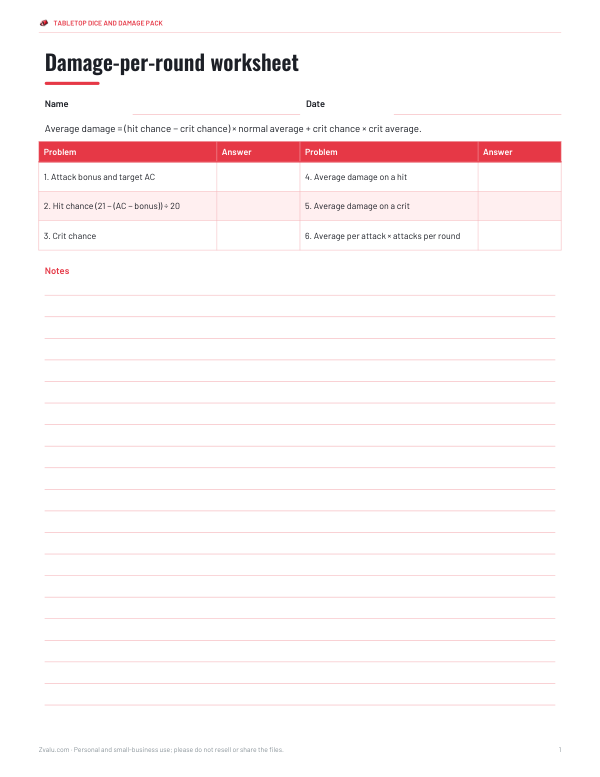
The roller stays free. The $3 pack adds printable combat trackers, HP logs, probability references and editable worksheets. Five worksheet/reference sets contain 12 resource files plus README (13 files total).
- Probability tables (PDF/DOCX)
- Damage worksheet (PDF/DOCX)
- Combat tracker (PDF/DOCX/XLSX)
- Hit-point log (PDF/DOCX/XLSX)
- d8 table template (PDF/DOCX)
Formats: PDF, DOCX, XLSX. Instant download after payment (link valid 72 hours, up to 5 downloads). AI-assisted: the templates were drafted with AI help and reviewed and laid out before publishing.
$3.00 USD, one-time 5 sets · 12 resource files + README (13 files total)
- Instant download
- 7-day refund
- Secure checkout by Stripe
7-day money-back guarantee. Full refund within 7 days of purchase, even after you download.
Free sample: Combat Tracker (PDF, 62 KB)
Full refund within 7 days — see the refund policy and license.
Free printables
Single sheets you can print right now, no sign-up. The full pack adds every sheet in one download plus the editable files.
 Printable Hit Point Log Sheet
 Printable d8 Table Template
Common d8 roll totals
These exact ranges and averages use fair d8s numbered 1 through 8.
| Roll | Minimum | Maximum | Average | Middle result(s) |
|---|---|---|---|---|
| 1d8 | 1 | 8 | 4.5 | 4 or 5 |
| 2d8 | 2 | 16 | 9.0 | 9 |
| 3d8 | 3 | 24 | 13.5 | 13 or 14 |
| 4d8 | 4 | 32 | 18.0 | 18 |
| 6d8 | 6 | 48 | 27.0 | 27 |
| 8d8 | 8 | 64 | 36.0 | 36 |
| 10d8 | 10 | 80 | 45.0 | 45 |
| 20d8 | 20 | 160 | 90.0 | 90 |
The d8 in numbers
| Dice | Range | Average | Most likely total |
|---|---|---|---|
| 1d8 | 1–8 | 4.5 | 1–8, all tied (12.5% each) |
| 2d8 | 2–16 | 9.0 | 9 (12.5% each) |
| 3d8 | 3–24 | 13.5 | 13 or 14 (9.4% each) |
| 4d8 | 4–32 | 18.0 | 18 (8.4% each) |
| 6d8 | 6–48 | 27.0 | 27 (6.9% each) |
| 8d8 | 8–64 | 36.0 | 36 (6.0% each) |
A single d8 is flat — every face from 1 to 8 has a 12.5% chance, and the average is 4.5. Add more dice and the totals bunch up around the middle, forming a bell-shaped curve, which is why 2d8 rolls a 9 far more often than a 2 or a 16.
Where the d8 is used
- Damage for many one-handed martial weapons in d20 fantasy games — longswords, battleaxes, rapiers, warhammers and morningstars — and for longbows and light crossbows.
- Hit dice for several middle-toughness character classes.
- Some spell and healing effects that scale with extra d8s.
- Random tables with eight entries, such as compass directions or weather.
- Teaching probability — eight equally likely outcomes make clean fractions.
Worked example
A character with a +5 attack bonus swings a longsword (1d8 + 3) at a creature with armour class 15. They need a 10 or higher on the d20, so they hit 55% of the time, and 5% of attacks are critical hits that roll 2d8 + 3. The average damage per swing is 4.35 — compared with 7.5 on every hit. With advantage the hit chance rises to 79.75% and average damage to 6.42.
Critical hits and resistance
In many d20 systems a critical hit doubles the number of damage dice — 1d8 + 3 becomes 2d8 + 3 — but not the flat modifier, and resistance halves the final damage, rounding down. Tick the boxes to apply either, and the distribution chart updates to show the new range and average. The attack-average section uses its own selected d20 critical threshold and the base dice count; the manual Critical hit checkbox applies only to the roller and its chart. Resistance applies to both. House rules vary.
Is the roller fair?
Each die uses crypto.getRandomValues, the browser’s cryptographic random number generator, with rejection sampling so all eight faces are exactly equally likely. The history panel counts every face rolled, and after 80 dice a chi-square test tells you whether the spread is consistent with a fair die. Expect streaks: in a fair sequence, three of the same number in a row happens about once every 64 rolls.
Reading the distribution chart
The bar chart uses the same 1–100 base dice, whole-number modifier, critical doubling, zero damage floor and Resistance rounding as the roller. Hover over a bar to see its percentage. With no modifier or damage adjustments, all 1d8 faces are equally likely; 2d8 peaks at 9, and 3d8 has tied peaks at 13 and 14. The standard deviation tells you how spread out the results are: about two-thirds of rolls land within one standard deviation of the average.
Hit points with a d8 hit die
| Level | Average HP gained (d8, taking the average) | Rolled range |
|---|---|---|
| 1st | Maximum: 8 + Constitution modifier | — |
| Each later level | 5 + Constitution modifier | 1–8 + Constitution modifier |
| After 5 levels (average) | 8 + 4 × 5 = 28 + 5 × Con | 12–40 + 5 × Con |
Many groups let players take the fixed average (rounded up to 5) instead of rolling, which avoids unlucky low rolls. Use the roller if your table rolls for hit points, and keep the results in the hit-point log from the pack.
Probability questions for the classroom
- What is the chance of rolling 8 on one d8? (1/8 = 12.5%)
- What is the chance of rolling at least one 8 with two d8s? (1 − (7/8)² ≈ 23.4%)
- Which total is most likely with 2d8, and why? (9 — it has the most combinations)
- What is the chance two d8s show the same number? (1/8)
- Roll 80 times and compare your counts with the expected 10 per face.
Advantage and disadvantage
Rolling the d20 twice and keeping the higher result (advantage) or the lower (disadvantage) changes hit chances a lot. If you normally hit on 55% of attacks, advantage raises that to about 80% and disadvantage lowers it to about 30%. Advantage also nearly doubles the chance of a critical hit, from 5% to 9.75%, which matters for weapons with bigger damage dice.
Physical d8s
A real d8 is an octahedron — eight triangular faces, with opposite faces usually summing to 9. Cheap dice can be slightly lopsided; a common home test is to float them in salt water and spin them to see whether one face keeps coming up. Precision-edged casino-style dice are the most balanced.
Privacy
Rolls happen in your browser and are not sent or stored.
Frequently asked questions
What is 8d8?
8d8 means eight eight-sided dice rolled together, with all faces added. The possible total is 8 to 64, and the average is 36.
What is the average for 10d8?
The average for 10d8 is 45.0, because each d8 averages 4.5 and 10 × 4.5 = 45.
Can I roll 20d8 here?
Yes. Set the number of d8 to 20; the total range is 20 to 160 and the average is 90.0.
What is the average of a d8?
4.5.
What is the average of 2d8?
9 — also the most likely total, with a 12.5% chance.
What weapons use a d8?
In d20 fantasy games, many one-handed weapons such as longswords and rapiers, plus longbows and light crossbows.
How does a critical hit work with a d8?
In many systems you roll the damage dice twice as many times: 1d8 becomes 2d8, plus the normal modifier.
Is this dice roller random?
Yes, it uses your browser’s cryptographic random generator.
What is the chance of rolling an 8?
1 in 8, or 12.5%, on each die.
What does resistance do?
It halves the total damage, rounding down.
Does advantage affect damage?
Not directly, but it raises the chance to hit and to score a critical hit, so average damage goes up.
Can I roll lots of d8s at once?
Yes, up to 100 in one roll.